

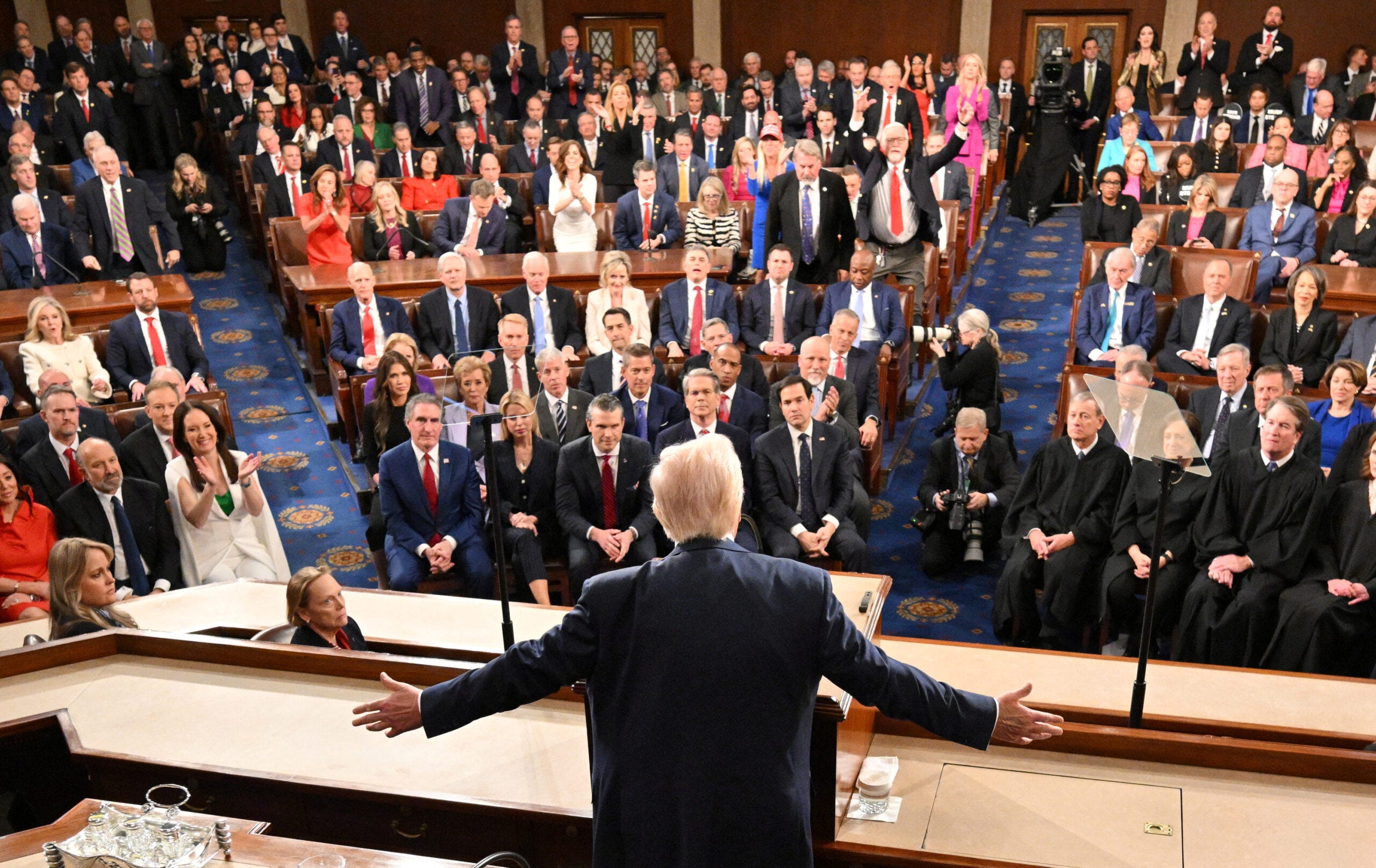
Congress was designed to restrain presidential power.
Instead, much of it has become afraid of the president.
That fear has changed how lawmakers speak, how they vote and whether they are willing to use the authority the Constitution gave them.
Republican members of Congress know that opposing Donald Trump can bring consequences.
A critical vote can invite a primary challenge.
A public disagreement can trigger denunciation, harassment and threats.
A refusal to obey can cost a committee assignment, a leadership position, campaign support or an entire political career.
So they calculate.
They soften their language.
They avoid interviews.
They condemn his conduct privately and defend it publicly.
They wait for someone else to object first.
And when no one does, they surrender together.
Fear has become the organizing principle of Congress.
It explains why lawmakers who once criticized Trump now praise him.
It explains why constitutional objections disappear when he demands loyalty.
It explains why members who witnessed the attack on the Capitol later helped erase its meaning.
It explains why Congress, a branch created to check executive power, has repeatedly chosen accommodation over resistance.
These lawmakers are not confused.
They are afraid.
They fear Trump’s anger.
They fear his supporters.
They fear losing office.
They fear becoming the next example used to frighten everyone else.
Some of those fears are understandable.
None of them excuse abandoning their duty.
Members of Congress did not take an oath to protect their careers.
They took an oath to protect the Constitution.
A Congress too frightened to exercise its power is not merely weak.
It is ineffective.
And an ineffective Congress leaves the country exposed to a president willing to test every limit it refuses to defend.
They Know Better
The most revealing fact about Trump’s control over Congress is that many Republican lawmakers do not actually believe everything they say on his behalf.
Behind closed doors, they have expressed alarm at his conduct, his judgment and his disregard for constitutional limits.
In public, they fall into line.
They vote for measures they once opposed.
They defend actions they once called unacceptable.
They repeat claims they know are false or remain silent while others repeat them.
Their silence is not proof that Trump has persuaded them.
It is proof that he has frightened them.
They fear his anger.
They fear his supporters.
They fear a primary challenger bearing his endorsement.
They fear losing committee assignments, leadership positions, campaign money and the careers around which they have built their identities.
Some also fear threats against themselves and their families.
Those fears may be real.
But fear does not release a public official from responsibility.
Members of Congress were given power precisely because exercising it would sometimes be difficult.
They were not elected merely to occupy seats, issue statements and protect themselves.
They were elected to act.
The Empty Foxhole
Standing up to a bully is difficult because the first person who speaks often stands alone.
Trump understands this.
He does not need to punish every dissenter.
He only needs to make examples of a few.
A Republican who criticizes him may face denunciation, harassment, political isolation or a Trump-backed primary opponent.
Others watch what happens and learn the lesson.
Stay quiet.
Apologize.
Change your vote.
Pretend you never objected.
This is how fear becomes discipline.
It explains why lawmakers who privately recognize danger continue to enable it publicly.
Each waits for someone else to go first.
Each fears fighting a losing battle in an empty foxhole.
But Congress was never supposed to be an army serving the president.
It is a separate branch of government.
Its members were given independent power precisely so they could resist a president who abused his own.
When they refuse to use that power, they do not merely protect themselves.
They abandon the country.
January 6 Should Have Ended It
The attack on the United States Capitol should have broken Trump’s hold over Congress.
Members hid as rioters entered the building.
Police officers were assaulted.
The peaceful transfer of power was interrupted.
Lawmakers experienced, in the most personal way possible, what happens when political intimidation escapes the screen and enters the real world.
For a brief moment, some appeared ready to tell the truth.
Then fear returned.
Most Republican senators voted to acquit Trump after his second impeachment.
Many House Republicans continued to embrace his false claims about the election.
Those who investigated January 6 or supported accountability were censured, removed from leadership, defeated in primaries or driven from the party.
The lesson was unmistakable.
Trump could inspire an assault on the institution where they served—and many of its members would still be more afraid of opposing him than of what he had unleashed.
That was the moment cowardice became complicity.
Congress Gave Away Its Power
The Constitution does not make Congress subordinate to the president.
Congress controls spending.
Congress writes laws.
Congress confirms appointments.
Congress conducts oversight.
Congress possesses the authority to investigate misconduct, reject unqualified nominees, limit executive excess and, in the gravest circumstances, remove a president from office.
Those powers mean little when the people entrusted with them are afraid to act.
A frightened Congress does not need to be formally abolished.
It simply stops resisting.
It permits the executive branch to expand.
It accepts decisions made without meaningful consultation.
It tolerates attacks on courts, prosecutors, inspectors general, civil servants, universities, journalists and political opponents.
It watches presidential power grow because challenging that power may carry a personal cost.
This is how checks and balances fail.
Not always through one dramatic seizure of authority, but through a thousand small acts of surrender.
Each silence makes the next silence easier.
Each capitulation makes the next demand seem less extraordinary.
Each refusal to act transfers a little more power from Congress to the president.
Eventually, the institution may still exist in name while failing to perform its constitutional purpose.
The Price America Pays
Congressional cowardice has consequences far beyond Washington.
When lawmakers will not defend election results, Americans lose confidence in democracy.
When they refuse to protect the rule of law, citizens begin to believe that justice depends on political loyalty.
When they allow threats and retaliation to govern their votes, public service becomes dangerous for anyone unwilling to obey.
When they accept falsehoods to preserve their careers, truth becomes partisan.
And when members of Congress demonstrate that fear works, they encourage its continued use.
Every capitulation strengthens the president.
Every silence widens the boundary of what he may attempt next.
Every excuse teaches future presidents that Congress can be intimidated into irrelevance.
The damage will not disappear when Trump eventually leaves office.
The precedent will remain.
The next president who wants unchecked power will already know which threats work, which institutions will retreat and how quickly lawmakers can be frightened into submission.
Congress is not merely failing to restrain one man.
It is teaching future presidents how easily it can be defeated.
The World Pays the Price
The consequences of a frightened Congress extend far beyond the United States.
For decades, much of the world has depended on American stability—not because every American decision was wise, but because allies believed the country’s institutions could restrain sudden impulses and preserve long-term commitments.
That confidence is weakening.
Foreign governments now watch a Congress that often appears unwilling to challenge Donald Trump, even when his actions threaten alliances, undermine democratic partners or contradict America’s stated principles.
They see support for Ukraine become vulnerable to one man’s grievances.
They see NATO commitments treated as bargaining chips.
They see democratic allies insulted while authoritarian rulers are praised, flattered or excused.
They see treaties, security guarantees and international agreements placed at risk because lawmakers are too frightened to confront the president who threatens them.
That uncertainty forces allies to prepare for an America they may no longer be able to trust.
European nations reconsider their defenses.
Asian allies question whether American commitments will survive a change in presidential mood.
Ukraine is left wondering whether the weapons and support promised today will still exist tomorrow.
Smaller democracies must calculate whether standing with the United States will protect them—or leave them exposed.
Adversaries are watching too.
Russia sees opportunities to divide NATO and weaken support for Ukraine.
China studies whether American political paralysis creates an opening in Taiwan or the Pacific.
Iran and North Korea observe how easily personal threats, flattery and political pressure can disrupt American policy.
Authoritarian leaders everywhere learn the same lesson:
They may not need to defeat the United States.
They may only need to influence one president and wait for Congress to surrender.
A fearful Congress therefore makes war more likely, diplomacy less credible and alliances less dependable.
It encourages aggression by creating uncertainty about whether America will respond.
It weakens democratic movements by showing that even the world’s most powerful democracy can be intimidated from within.
It tells allies that American promises may depend less on law and national interest than on the impulses of one man.
The world does not need an America that dominates every decision.
It needs an America whose word can be trusted, whose institutions function and whose elected representatives are willing to defend the commitments they make.
When Congress is too afraid to restrain a president, the entire world becomes less stable.
The empty foxhole is not only in Washington.
Its consequences reach every nation that depends on American courage, consistency and leadership.
Fear Explains It. Fear Does Not Excuse It.
It is possible to understand why lawmakers are afraid.
Trump can destroy careers.
He can direct public rage toward an individual with a few words.
He can encourage a primary challenge, cut off political support and turn former allies into enemies before millions of followers.
Some lawmakers have received genuine threats.
Their families have lived with security concerns no public servant should have to endure.
But courage has never meant the absence of fear.
Courage means acting despite it.
Members of Congress ask Americans to send their sons and daughters into battle.
They praise soldiers, police officers and first responders who place duty above personal safety.
Yet many of these same lawmakers will not risk losing an election to defend the Constitution.
That is the moral contradiction at the center of Trump’s Congress.
They celebrate courage in others.
They excuse cowardice in themselves.
They Are Not Powerless
The tragedy is that Congress could stop much of this.
Republican lawmakers do not need to agree with Democrats.
They do not need to abandon conservative principles.
They do not even need to oppose Trump on every policy.
They need only remember that they are representatives, not servants.
A handful of senators can reject an unqualified nominee.
A committee chair can insist on oversight.
House members can refuse legislation written only to satisfy presidential demands.
Congressional leaders can defend their institution rather than surrender it.
One act of resistance makes the next one easier.
Fear is contagious.
So is courage.
There have been occasional signs that some Republicans are becoming more willing to say no.
But standing up only when Trump is politically weakened, when elections are approaching or when public opinion has shifted is not bravery.
It is self-preservation.
Courage is telling the truth when the price is still high.
Courage is standing in the empty foxhole before it becomes safe to enter.
History Will Not Accept Their Excuses
Members of Congress may tell themselves that they had no choice.
They may say the political environment was too dangerous, their voters were too angry or resistance would have ended their careers.
History has heard those explanations before.
It rarely honors them.
These lawmakers were not powerless citizens living under an absolute ruler.
They held constitutional authority.
They had platforms, votes, staffs, committees and access to the national press.
They possessed more ability to resist than almost anyone in the country.
And many chose submission.
Donald Trump’s power has never come only from his own aggression.
It has also come from the fear of those who could have stopped him.
The president threatened.
Congress obeyed.
The president demanded loyalty.
Congress surrendered its independence.
The president tested the limits.
Congress moved them.
The danger facing America is not simply that one man seeks too much power.
It is that too many elected officials are too afraid to deny it to him.
They know better.
They have the power to act.
And still, they remain silent.
That is not caution.
That is not strategy.
That is cowardice.
Original LIFE Magazines are authentic issues published between 1936 and 2000.
Available at: https://www.OriginalLIFEmagazines.com
The perfect milestone gift.